
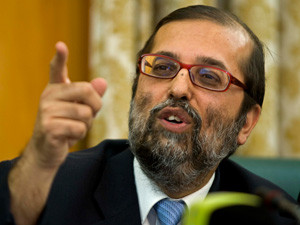
Minister of communications Yunus Carrim has launched the Freevision satellite service to the GaMphahlele in Lepelle Nkumpi Municipality, in Limpopo, an area that has intermittent broadcasting signal.
Carrim says this forms part of government's bid to bring communications services to the poor and those in rural areas. The Department of Communications (DOC) is working with provincial governments and municipalities across the country to ensure the five million South Africans without access to a television signal are, over time, "significantly reduced", he says.
The DOC, says Carrim, will roll out services in the GaMphahlele area in a phased manner. The minister yesterday handed over Freevision satellite dishes, decoders and TV sets to 10 indigent and child-headed households in the area. TV sets were also installed at the Tribal Council offices and the local post office.
"As a community, you now have access to the SABC 24-hour channel on a free-to-air platform. One of the good things about this is that the community will receive more news and information in Sepedi, your local language," said Carrim, addressing the province.
Cellphone employment
At the same time, Carrim has equipped two primary and three high schools in the area with Internet-enabled computers, which he says will go towards improving the quality of education in the rural district.
"One of the key programmes that will be made available is on maths and science. If we want the young to be employed, and to succeed professionally, they have to have a good grounding in maths and science."
He further called on SA's mobile operators to work with the relevant stakeholders to educate South Africans about how cellphones can be used to create employment.
Migration plan
As part of government's digital migration process, state-owned signal distributor Sentech will use satellite to cover areas that are remote and unable to receive digital signal terrestrially. It aims to have 88% of the population covered terrestrially by the end of March next year.
Sentech has already rolled out the terrestrial digital broadcasting signal to 82% of all South Africans, and satellite - the chosen technology for the area around the Square Kilometre Array (SKA) - will fill in the remaining 12%.
The SKA area, in the remote Karoo, is radio sensitive, so transmitters could not be deployed. It was also chosen as the soft-launch site last October to prove that digital television worked.
Share

