
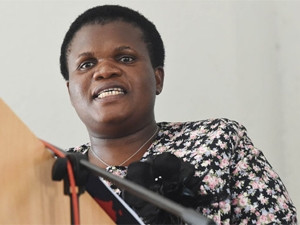
Communications minister Faith Muthambi has described government's march towards digital migration as "nothing short of ground-breaking", and a process that is set to open the "exciting world and possibilities of communication to millions".
Speaking at the opening of the Free State Provincial Government ICT Summit yesterday, Muthambi noted the digital migration policy will see a rollout of public services channels for youth, women, and education and e-government services.
"We are most excited about the potential of e-government services, which will unlock access to basic Internet services and digital information for millions of our people.
"The process is well advanced and the migration process will begin to take shape in the next few months. Later this year, we will be launching our digital migration awareness campaign in the Free State to explain the benefits of digital television beginning with the rollout of STBs [set-top boxes] to identified poor households and areas bordering Lesotho, which may experience broadcast interference."
She pointed out, in keeping with government's policy to grow small businesses, STB installation companies will be drawn from local communities in the Free State, to create work opportunities for the youth to enter the ICT sector.
Cabinet approved the final amendments to the Broadcasting Digital Migration Policy in March, clearing the way for the implementation of digital migration.
Delivering her budget vote speech last month, Muthambi stated government is mindful of the fact SA will not meet the 17 June analogue switch-off date, as set by the International Telecommunication Union.
She explained government is signing bilateral engagements with six neighbouring countries - Botswana, Zimbabwe, Namibia, Mozambique, Lesotho and Swaziland - to minimise cross-border radio frequency spectrum interference, once SA misses the switch-over deadline later this month.
Dynamic and rapid
Addressing the Free State ICT Summit yesterday, Muthambi noted ICT is a dynamic and rapid technological field. "In ICT, change is constant and what was yesterday's breakthrough is tomorrow's reality.
"When we attained our democracy in 1994, SA was opened to a whole new world of technological possibilities. The ICT sector has been at the forefront of this revolution and continues to lead the way in uncovering new frontiers."
She pointed out governments all over the world are grappling with how to use benefits of ICT for the betterment of their people. "We too must find ways to make ICT work for all South Africans. We dare not allow a new divide to develop between those with access to information and technology, and those who don't enjoy access," she said.
"The recently released Statistics South Africa General Household Survey 2014 shows 48.7% of South African households had at least one member who had access to or used the Internet, either at home, work, place of study or Internet caf'es. It shows that access using all available means stands at 48.7% in the Free State.
"It also found that only one-tenth of households had access to the Internet at home. Predictably, it found that access is much wider in metropolitan areas as opposed to rural areas."
Muthambi referred to the statistics as encouraging on the one hand, but deeply troubling on the other, saying too many citizens are still denied access to information and the life-changing benefits it brings.
"Therefore, government, in partnership with industry and civil society, has to find ways to make ICT relevant and accessible to more South Africans. The roll-out of free WiFi across large metro areas is a start, but we cannot stop there."
Muthambi noted government has identified the communications sector as a critical growth area. "The National Development Plan recognises that the ongoing development of quality communications infrastructure, services, content and applications is key to the rapid economic, social and cultural development of the country."
Share

