
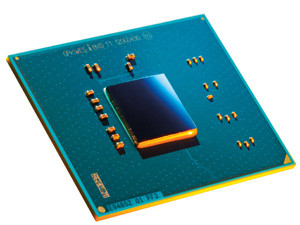
Intel has launched a server system-on-chip (SoC) aimed at high-density computing and microservers.
The new Atom A1200 is the first of the Atom family to be designed for servers, and has a low-power draw of 6W.
The A1200 takes aim directly at competitor ARM, whose low-power processors are starting to make inroads into server applications, with the recent introductions of 64-bit ARMv8 CPU cores.
"The data centre continues to evolve into unique segments," says Vince Resente, enterprise technology specialist at Intel SA. "We recognised several years ago the need for a new breed of high-density, energy-efficient servers and other data centre equipment. Today, we are delivering the industry's only six-watt SoC that has key data centre features."
The A1200 processors are aimed at high-density server environments. Microservers such as rack-mounted blade servers, appliances, and networking and storage devices demand small footprints and energy-efficiency.
Intel partners are already putting A1200-based products on the roadmap - Intel claims "over 20" microserver products are shipping already.
At the high end, the A1200 is aimed at data centres packing many hundreds of compute nodes into racks, where power consumption and cooling become as important as raw computing capability. "You can mount over 1 000 A1200 nodes in a 42U rack," notes Resente.
"Organisations supporting hyperscale workloads need powerful servers to maximise efficiency and realise radical space, cost and energy savings," says Paul Santeler, VP and GM, Hyperscale business unit, industry-standard servers and software at HP. "HP servers power many of those organisations, and the Intel Atom processor S1200 will be instrumental as we develop the next wave of application-defined computing to dramatically reduce cost and energy use for our customers."
Target environments include cloud services, database processing and other intensive scale-out applications. Intel's Xeon processors are the company's traditional solution for that space, but the Atom line-up promises much greater density. The Atom's comparatively less powerful processor leaves a clear segmentation - Xeon offers more grunt than Atom and will remain better suited to compute-intensive tasks.
The S1200 will ship in three variants, with 64-bit processors ranging from 1.6GHz to 2.0GHz, with prices starting at $54. Each can support up to 8GB of memory, and offers eight lanes of PCI Express, and Gigabit Ethernet (the latter still separately mounted, due for integration into the SoC in time). Since the A1200s use Ethernet for interconnect, Intel's networking acquisitions, such as Fulcrum Microsystems in 2011, are instrumental in its data centre offering, giving the chipmaker the high-bandwidth and high-density interconnect these systems need.
Low-power server computing is featuring strongly on Intel's roadmap. Xeon debuted in 2006 with power consumption of 40W, and dropped to 17W in 2012 with the introduction of Intel's 22nm transistor technology. Atom, a low-power device in both wattage and processing power, is pushing the boundary further to 6W. Both lines will be developed further in 2013, with "Avoton"-based Atom processors and "Haswell" Xeon processors on the roadmap.
Share

