
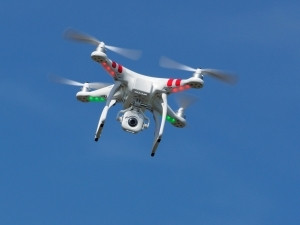
Quadrocopters - the small, remote-controlled aircraft with four propellers - could yet play a greater role in finding practical solutions to modern challenges as wider research leads to the discovery of greater possibilities.
So says Mark M"uller, a South African robotics student and PhD candidate at Switzerland-based Federal Institute of Technology. He will form part of his institution's team demonstrating the technology's potential along with global counterparts at the world congress of the International Federation of Automatic Control conference, taking place in Cape Town at the end of this month.
M"uller's research into what robots can collaboratively do in autonomous flight is based on the Flying Machine Arena (FMA) system that uses motion capture, wireless networking and custom software to execute commands. "We try to find the limits and possibilities that you can get out of the system and we'll present a public lecture at the congress, where we will demonstrate the work we do and how the system works."
M"uller's demonstration, which is free for the public, will take place on 29 August.
Innovative solutions
He says much of their work is taken up by creating algorithms that instruct the quadrocopters where to be and what to do within the FMA, but the research has shown him what practical possibilities may be accomplished in the modern context. "People have used them to monitor wildlife, especially as they can fly low and close to sea-level in order for the mounted camera to provide a video feed."
According to M"uller, further research and development could see quadrocopters applied to repair electric power lines, which are often laborzous to access.
"In addition to the flying machines, our system includes laptop computers, two-way radios and a set of overhead cameras to create something like an indoor GPS. Once we start a particular program, the flying robots perform their acrobatic work routines autonomously. Data is captured automatically and used to improve their manoeuvres, turning it into a 'learning' system."
Amazon controversy
In a move that made headlines late last year, Amazon announced plans to introduce its Prime Air initiative - a new delivery system to get packages into customers' hands in 30 minutes or less using unmanned aerial vehicles called octocopters.
Although Amazon says it plans to push ahead with its initiative once US-based Federal Aviation Authority (FAA) regulations are in place, the move has drawn criticism for its possible privacy infringements.
The FAA currently only allows the use of unmanned aircraft systems (UAS) by public entities on a case-by-case basis. It recently said it will establish regulations and standards for the safe integration of remote-piloted UAS to meet increased demand.
Share

