Share


About Rimini Street, Inc.
Rimini Street, Inc. (Nasdaq: RMNI) is a global provider of enterprise software products and services, the leading third-party support provider for Oracle and SAP software products and a Salesforce partner. The Company offers premium, ultra-responsive and integrated application management and support services that enable enterprise software licensees to save significant costs, free up resources for innovation and achieve better business outcomes. To date, more than 5,000 Fortune 500, Fortune Global 100, midmarket, public sector and other organizations from a broad range of industries have relied on Rimini Street as their trusted application enterprise software products and services provider. To learn more, please visit http://www.riministreet.com, follow @riministreet on Twitter and find Rimini Street on Facebook and LinkedIn. (IR-RMNI)
Forward-Looking Statements
Certain statements included in this communication are not historical facts but are forward-looking statements for purposes of the safe harbor provisions under The Private Securities Litigation Reform Act of 1995. Forward-looking statements generally are accompanied by words such as “may,” “should,” “would,” “plan,” “intend,” “anticipate,” “believe,” “estimate,” “predict,” “potential,” “seem,” “seek,” “continue,” “future,” “will,” “expect,” “outlook” or other similar words, phrases or expressions. These forward-looking statements include, but are not limited to, statements regarding our expectations of future events, future opportunities, global expansion and other growth initiatives and our investments in such initiatives. These statements are based on various assumptions and on the current expectations of management and are not predictions of actual performance, nor are these statements of historical facts. These statements are subject to a number of risks and uncertainties regarding Rimini Street’s business, and actual results may differ materially. These risks and uncertainties include, but are not limited to, adverse developments in and costs associated with defending pending litigation or any new litigation; changes in the business environment in which Rimini Street operates, including the impact of any recessionary economic trends and changes in foreign exchange rates, as well as general financial, economic, regulatory and political conditions affecting the industry in which we operate and the industries in which our clients operate; the evolution of the enterprise software management and support landscape and our ability to attract and retain clients and further penetrate our client base; significant competition in the software support services industry; customer adoption of our expanded portfolio of products and services and products and services we expect to introduce; our ability to sustain or achieve revenue growth or profitability and manage our cost of revenue; estimates of our total addressable market and expectations of client savings relative to use of other providers; variability of timing in our sales cycle, and risks relating to retention rates; the loss of one or more members of our management team; our ability to attract and retain qualified employees and key personnel; challenges of managing growth profitably; our need and ability to raise additional equity or debt financing on favorable terms and our ability to generate cash flows from operations to help fund increased investment in our growth; the impact of environmental, social and governance (ESG) matters; actions in response to any lingering impacts of the COVID-19 pandemic and its economic, operational and financial impacts on our business; risks associated with global operations; our ability to prevent unauthorized access to our information technology systems and other cybersecurity threats, protect the confidential information of our employees and clients and comply with privacy regulations; our ability to maintain an effective system of internal control over financial reporting; our ability to maintain, protect and enhance our brand and intellectual property; changes in laws and regulations, including changes in tax laws or unfavorable outcomes of tax positions we take, or a failure by us to establish adequate tax reserves; our credit facility’s ongoing debt service obligations and financial and operational covenants on our business and related interest rate risk, including uncertainty from the transition to SOFR or other interest rate benchmarks; the sufficiency of our cash and cash equivalents to meet our liquidity requirements; the amount and timing of repurchases, if any, under our stock repurchase program and our ability to enhance stockholder value through such program; uncertainty as to the long-term value of Rimini Street’s equity securities; catastrophic events that disrupt our business or that of our clients; and those discussed under the heading “Risk Factors” in Rimini Street’s Annual Report on Form 10-K filed on March 1, 2023, and as updated from time to time by Rimini Street’s future Annual Reports on Form 10-K, Quarterly Reports on Form 10-Q, Current Reports on Form 8-K, and other filings by Rimini Street with the Securities and Exchange Commission. In addition, forward-looking statements provide Rimini Street’s expectations, plans or forecasts of future events and views as of the date of this communication. Rimini Street anticipates that subsequent events and developments will cause Rimini Street’s assessments to change. However, while Rimini Street may elect to update these forward-looking statements at some point in the future, Rimini Street specifically disclaims any obligation to do so, except as required by law. These forward-looking statements should not be relied upon as representing Rimini Street’s assessments as of any date subsequent to the date of this communication.
© 2023 Rimini Street, Inc. All rights reserved. “Rimini Street” is a registered trademark of Rimini Street, Inc. in the United States and other countries, and Rimini Street, the Rimini Street logo, and combinations thereof, and other marks marked by TM are trademarks of Rimini Street, Inc. All other trademarks remain the property of their respective owners, and unless otherwise specified, Rimini Street claims no affiliation, endorsement, or association with any such trademark holder or other companies referenced herein.
About Non-GAAP Financial Measures and Certain Key Metrics
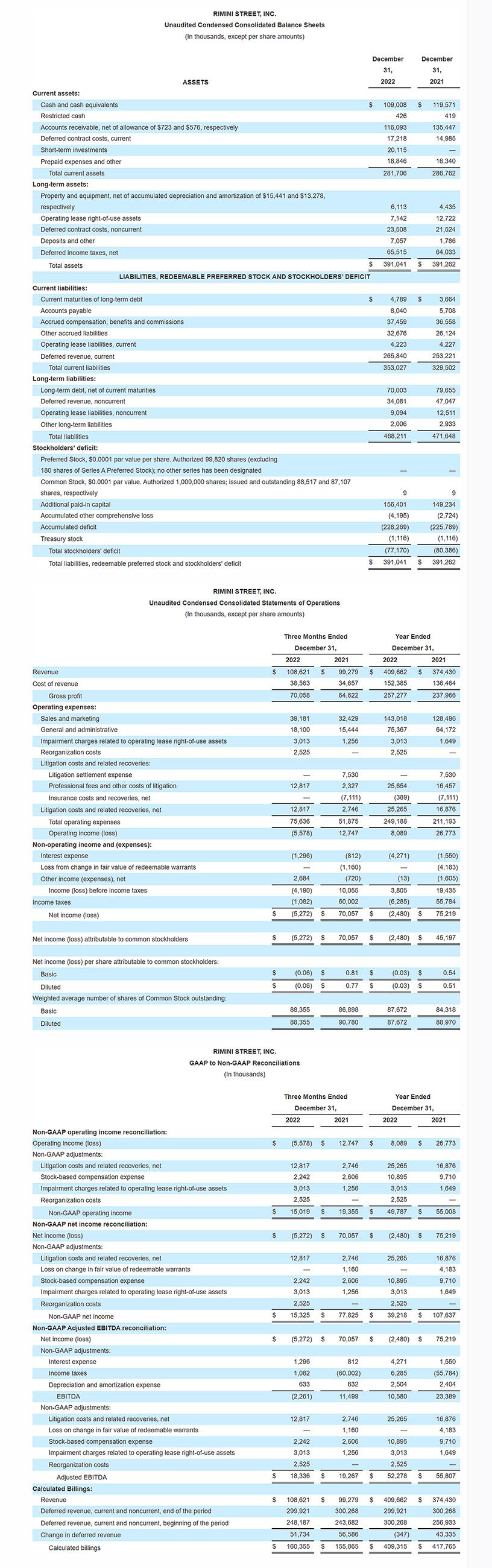
To provide investors and others with additional information regarding Rimini Street’s results, we have disclosed the following non-GAAP financial measures and certain key metrics. We have described below Active Clients, Annualized Recurring Revenue and Revenue Retention Rate, each of which is a key operational metric for our business. In addition, we have disclosed the following non-GAAP financial measures: non-GAAP operating income, non-GAAP net income, EBITDA, Adjusted EBITDA and Billings. Rimini Street has provided in the tables above a reconciliation of each non-GAAP financial measure used in this earnings release to the most directly comparable GAAP financial measure. A reconciliation of Adjusted EBITDA is not available on a forward-looking basis because the Company is unable to predict its net income with reasonable certainty due to the effects of foreign currency exchange rates, income tax provisions, future interest rates on our variable rate indebtedness, the non-cash component of employee compensation expense, changes in its working capital and financing needs, and other such items without unreasonable effort. Similarly, the high variability of certain expense items renders us unable to provide a reconciliation to the guidance as to margin and selected expenses as a percentage of revenue presented in our earnings conference call. These items, which depend on various factors and could be material to the Company’s results computed in accordance with GAAP, are uncertain. Due to a valuation allowance for our deferred tax assets, there were no tax effects associated with any of our non-GAAP adjustments. These non-GAAP financial measures are also described below.
The primary purpose of using non-GAAP measures is to provide supplemental information that management believes may prove useful to investors and to enable investors to evaluate our results in the same way management does. We also present the non-GAAP financial measures because we believe they assist investors in comparing our performance across reporting periods on a consistent basis, as well as comparing our results against the results of other companies, by excluding items that we do not believe are indicative of our core operating performance. Specifically, management uses these non-GAAP measures as measures of operating performance; to prepare our annual operating budget; to allocate resources to enhance the financial performance of our business; to evaluate the effectiveness of our business strategies; to provide consistency and comparability with past financial performance; to facilitate a comparison of our results with those of other companies, many of which use similar non-GAAP financial measures to supplement their GAAP results; and in communications with our board of directors concerning our financial performance. Investors should be aware however, that not all companies define these non-GAAP measures consistently.
Billings represents the change in deferred revenue for the current period plus revenue for the current period.
Active Client is a distinct entity that purchases our services to support a specific product, including a company, an educational or government institution, or a business unit of a company. For example, we count as two separate active clients when support for two different products is being provided to the same entity. We believe that our ability to expand our active clients is an indicator of the growth of our business, the success of our sales and marketing activities, and the value that our services bring to our clients.
Annualized Recurring Revenue is the amount of subscription revenue recognized during a fiscal quarter and multiplied by four. This gives us an indication of the revenue that can be earned in the following 12-month period from our existing client base assuming no cancellations or price changes occur during that period. Subscription revenue excludes any non-recurring revenue, which has been insignificant to date.
Revenue Retention Rate is the actual subscription revenue (dollar-based) recognized over a 12-month period from customers that were clients on the day prior to the start of such 12-month period, divided by our Annual Recurring Revenue as of the day prior to the start of the 12-month period.
Non-GAAP Operating Income is operating income adjusted to exclude: litigation costs and related recoveries, net, stock-based compensation expense and impairment charge related to operating right-of-use assets. The exclusions are discussed in further detail below.
Non-GAAP Net Income is net income adjusted to exclude: litigation costs and related recoveries, net, loss on change in fair value of redeemable warrants, stock-based compensation expense and impairment charge related to operating right-of-use assets. These exclusions are discussed in further detail below.
Specifically, management is excluding the following items from its non-GAAP financial measures, as applicable, for the periods presented:
Litigation Costs and Related Recoveries, Net: Litigation costs and the associated insurance and appeal recoveries related to outside costs of litigation activities. These costs and recoveries reflect the ongoing litigation we are involved with, and do not relate to the day-to-day operations or our core business of serving our clients.
Loss on Change in Fair Value of Redeemable Warrants: We have excluded the losses on redeemable warrants related to the change in fair value of these instruments given the financial nature of this fair value requirement. We are not able to manage these amounts as part of our business operations nor are the costs core to serving our clients, and therefore we have excluded them.
Stock-Based Compensation Expense: Our compensation strategy includes the use of stock-based compensation to attract and retain employees. This strategy is principally aimed at aligning the employee interests with those of our stockholders and to achieve long-term employee retention, rather than to motivate or reward operational performance for any particular period. As a result, stock-based compensation expense varies for reasons that are generally unrelated to operational decisions and performance in any particular period.
Impairment Charges Related to Operating Lease Right-of-Use Assets: This relates to impairment charges on our leased assets for a portion of one of our locations as we no longer use the space and have revised our estimated loss.
Reorganization Costs: The costs consist primarily of severance costs associated with the Company's reorganization plan.
EBITDA is net income adjusted to exclude: interest expense, income tax expense, and depreciation and amortization expense.
Adjusted EBITDA is EBITDA adjusted to exclude: litigation costs and related recoveries, net, loss on change in fair value of redeemable warrants, stock-based compensation expense, impairment charges related to operating right-of-use assets and reorganization costs, each as discussed above.
View source version on businesswire.com: https://www.businesswire.com/news/home/20230301005433/en/
Contacts
Investor Relations Contact
Dean Pohl
Rimini Street, Inc.
+1 925 523-7636 dpohl@riministreet.com
Media Relations Contact
Janet Ravin
Rimini Street, Inc.
+1 702 285-3532 pr@riministreet.com