
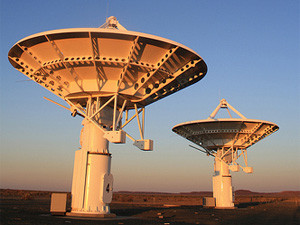
The Square Kilometre Array (SKA) project is significantly investing in local education, in an effort to train skilled people to participate in the project in future.
Yesterday, the Department of Science and Technology (DST) and SKA SA unveiled two community initiatives in Carnarvon, in the Karoo region, to boost maths and science skills in this and other surrounding towns.
Science and technology minister Derek Hanekom, alongside Northern Cape premier Sylvia Lucas and provincial MEC for education Grizelda Cjiekella, launched the e-Schools Initiative and opened a new community knowledge centre.
The SKA SA e-Schools Initiative is a R2.5 million project that will deliver ClassMate laptops, connectivity and training to five schools near the SKA project. The laptops are pre-loaded with learning materials, lesson plans and tutorials focused on mathematics, physical science, life science and astronomy.
The new community knowledge centre at the Bonteheuwel Library in the town gives the community access to more than 50 computers, a data projector, printer and Internet connectivity, as well as software, training and ongoing support and maintenance of the centre.
More than 10 private companies contributed to make the e-Schools Initiative and community centre possible.
Hanekom has lauded the generous support government has received from the private sector. "This support will enable the community to participate in the SKA initiative and will certainly bring about improvements in the lives of the local people. We look forward to seeing more and more learners benefit from this initiative and, in future, work on the SKA project itself as engineers, technicians and scientists," he says.
Tracy Cheetham, SKA SA GM: people support and development, communications and project secretariat, says the SKA project should encourage learners to pursue maths, science and technology at a tertiary level and possibly join the SKA project in future. "Developing a sustainable educational ecosystem around the SKA project will not only benefit the community, schools, teachers and learners, but, in the longer term, the SKA project as a workplace and SA as a nation," she says.
The e-Schools Initiative and community knowledge centre add to earlier investments already made in the local community, including a cyber lab, at Carnarvon High School.
Undergrad training
SKA SA has also funded a workshop that is set to take place in December, where leading astronomers from several international institutions will train a group of young astronomy students at an introductory radio astronomy school hosted by the University of KwaZulu-Natal.
The SKA School is aimed at preparing 40 South African undergraduate students in the methods required to work with data from the Karoo Array Telescope (MeerKAT) and the future SKA telescope.
The workshop, taking place from 30 November to 5 December, will see students working with astronomers from Canada, France, India and the US. The students, who are studying science or engineering at various universities throughout SA, share a common interest in pursuing a career in astronomy. The SKA School will conclude with local and international radio astronomers presenting their research.
"We are really happy to support this training school and collaborative workshop," says Dr Bernie Fanaroff, director of the South African SKA project. "These activities are key to training the next generation of South African scientists and building our knowledge economy."
Earlier this month, seven Ghanaians arrived in SA to begin training on the independent operation and maintenance of radio telescopes in Africa in support of the SKA. They are the first technical team from Africa to receive training as part of the African Very Long Baseline Interferometry Network programme.
The SKA is an international project to build a mega telescope that will be 50 times more sensitive and produce 10 000 times the survey speed of the best current-day telescopes. Its core will be located in SA, with a smaller array sited in Australia.
Share

