There's nothing quite like the feel of a tailored suit, which is why buying off the rack seldom results in a good fit. The same can be said for investing in technology for your business; you want your operations to be supported by software that fits perfectly. That rarely happens though, as out-of-the-box solutions offer little in the way of customisation.
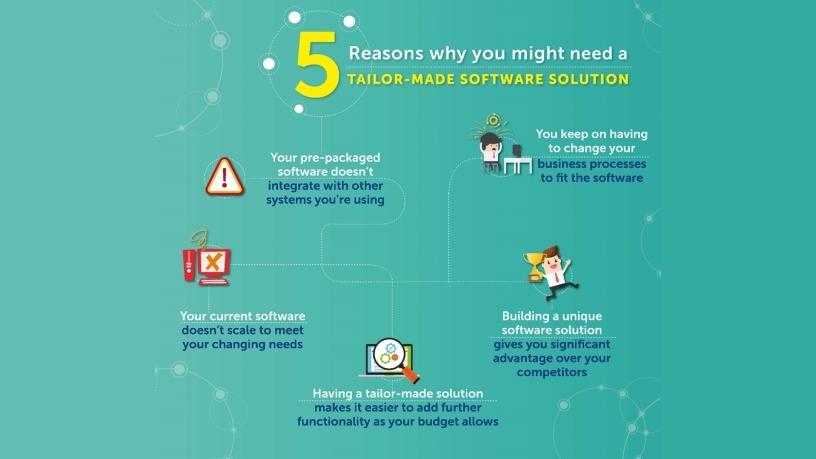
At a certain point, it might be worthwhile to commission a tailor-made solution. Perhaps your pre-packaged software doesn't integrate with other systems you're using, and you're spending too much time trouble-shooting to make your systems integrate. Perhaps your current software doesn't scale to meet your ever-changing needs - your business is growing and it is too expensive and time-consuming to add the functionality you require.
A well-designed custom-built solution will give you a significant advantage over your competitors as the software will exactly fit your business processes. It could even create new income streams if you resell or license it.
This answers the "why" of custom development, now let's look at the "what". What questions should you ask when commissioning a tailor-made software solution for your company?
1. Do you need custom-fit or tailor-made? In other words, do you just need your current software solution to fit your needs, or do you need new software developed from scratch? Some of the shelf products require some customisation - some base products still need tweaking to specific needs. The software should fit into the business process. You can't smash a square peg into a round hole!
2. Will the solution be built on an existing platform or system? If so, the costs should be lower than writing all-new code.
3. What languages does your development team use? This question is important because you want to be sure that your solution is being coded in a programming language that is popular (so there are plenty of developers using it) and accessible.
4. Who takes the brief? Ideally, the manager in charge of your custom development project is a multidisciplinary individual who is able to take insights from your business and translate these requirements into a robust brief for the developers to execute. They have business, management and technical skills as well as significant experience.
5. Who retains the copyright? You the customer should hold the copyright to your custom-built software solution, leaving you free to resell or license it to other companies in your industry who might have a use for it.
You don't need to hire a team of developers in-house; it's challenging to interview and retain staff for a skillset that's not your speciality.
When you outsource, you should be able have someone function as your Chief Technology or Chief Information Officer, and become part of the decision-making process when it comes to all things software development-related. Your custom-built software solution should match the unique needs of your business.
A software development partner needs to take the time to find out how your business operates, what your business needs, and how a tailor-made solution can make you more efficient and profitable. Not only that, but as your business evolves, they should ensure that your software solution does too.
Share


Singular Systems
Singular Systems believes it is well positioned to be a long-term partner providing expertise as well as the scalability to support a business from inception through to maturity. Singular has developed the capacity and skillset to execute rapid development in changing environments, helping clients achieve success through dynamic partnerships.
Editorial contacts