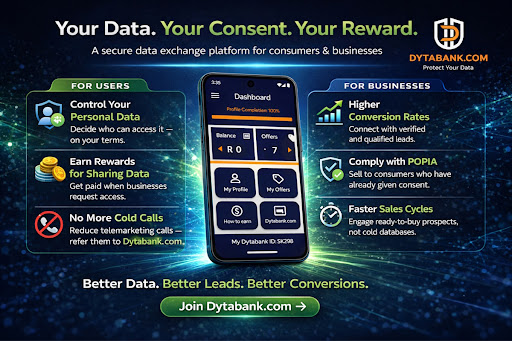
As South Africa’s Ministry of Trade, Industry and Competition tightens regulation around unsolicited telemarketing through the National Consumer Commission (NCC) opt-out registry, a local technology firm is proposing a broader solution: redesigning how personal data is exchanged in the first place.
Developed by Amidel, Dytabank.com is a patented and secure digital platform that enables individuals to control, manage and monetise their personal and financial information. Instead of simply blocking unwanted calls, it creates a consent-driven marketplace where companies can request access to verified data.
Bheki Ndabandaba, Amidel’s Chief Executive, says the platform is intended to complement regulatory efforts. “The NCC’s opt-out registry will help consumers block unwanted marketing calls, but Dytabank goes further. It creates a structured, lawful exchange of information that benefits both consumers and businesses.”
From frustration to structured engagement
Unsolicited telemarketing remains a persistent frustration. Despite the Protection of Personal Information Act (POPIA) mainly enforced through South Africa’s Information Regulator, many consumers are still contacted via outdated or purchased databases. During these calls, personal information is often confirmed or updated, with little visibility into how it will be stored or shared.
While blocking all marketing contact offers protection, it can also mean missing relevant or beneficial offers. Dytabank introduces a different model: engagement based on explicit, traceable consent.
“Personal data is one of the most valuable assets in today’s economy, yet individuals have historically had limited control over how it is used,” Ndabandaba says. “We place consent, transparency and financial benefit back in the hands of the data owner.”
How the platform works
Dytabank allows individuals to securely ‘bank’ their personal data. Users register via secure mobile app onboarding using their cellphone number and e-mail address, after which they set up a confidential PIN for authentication. They then complete a profile that may include personal, insurance and financial information typically requested during a financial needs analysis.
An Active Profile Status indicator shows that the information is complete and up to date, giving companies confidence in the accuracy of the data.
When a telemarketer or service provider wants to engage, the process changes fundamentally. Instead of collecting information during a 10-15 minute cold call, the company must first register and undergo verification on the platform. It then submits a formal request to access an individual’s profile using their cellphone number.
The user receives a notification and can approve or decline the request on their Dytabank app. If declined, no data is shared. If approved, the company pays a transaction fee to access the verified profile, and the user is compensated for granting access. Only then can the company present a tailored offer that is based on information lawfully provided by the client
A fair digital marketplace
The model creates a regulated digital marketplace for personal information. Companies gain access to accurate, current data rather than incomplete call lists, enabling more relevant proposals. Instead of generic sales scripts and repetitive qualification questions, offers are based on verified information.
For businesses, this will improve efficiency and conversion rates. For consumers, it reduces interruptions and eliminates the need to repeatedly disclose the same information.
Compliance and security by design
In South Africa’s strict data protection environment, compliance is central to the platform’s architecture.
POPIA prohibits the sharing of personal information without consent. Dytabank embeds consent into every transaction, with each request, approval and access instance recorded to create an auditable trail.
All interested reputable companies must register and undergo verification before operating on the platform, reducing exposure to scammers and fraudulent actors. Users can also manage their preferences through a telemarketer opt-out feature, selecting which industries may request access to their data.
Security controls include OTP and PIN-based authentication, transaction logging and layered access management. By combining secure technology infrastructure with Amidel’s expertise in cyber security and enterprise IT, the platform aims to ensure that consent is enforced rather than assumed.
Beyond telemarketing
Although telemarketing is the immediate use case, the broader ambition is to reduce duplication in how personal information is shared across sectors.
South Africans routinely resubmit the same data to banks, insurers, healthcare providers and government departments, increasing administrative burden and the risk of data breaches. A secure, consent-driven data pipeline could streamline these interactions while maintaining individual control.
“In the digital age, ownership must mean control,” Ndabandaba says. “Personal information should work for the individual, not against them.”
As enforcement around unsolicited marketing strengthens, Dytabank offers a solution that complements regulatory efforts by balancing the needs of both businesses and consumers/data owners: a proactive platform in which individuals manage, protect and derive value from their data within a secure ecosystem.
“This is the type of problem that needs collaboration in order to solve. So Amidel is open to partnering with government, private sector and community organisations in order to address this problem,” says Ndabandaba.
Join thousands who have embraced a new way of exchanging personal data: visit Dytabank.com or download the app from your app store.
Share

