A few years ago, data analysis and assessments - understanding the quality and structure of data assets within an application, was a relatively ill-defined area within a company's IT strategy.
This has changed with applications available to perform these tasks and is now a critical part of any successful data migration or data governance strategy.
While businesses continue to evolve and change, one thing remains constant - data is continuous and growing at a 40% compound annual rate.
Ixia Consulting specialises in all aspects of data management, and part of its offering is performing a data assessment as a precursor to a data migration or data governance strategy.
What the company generally finds working with data is that the quality of data remains an issue unless addressed and remedial action taken, as businesses are requiring access to reliable, consistent and clean data in a speedy manner to assist with strategic decision-making.
Ixia Consulting recently performed a data quality assessment on master data for a large company with different business units - each operating their own ERP and now starting a process to consolidate the various legacy source systems by migrating to an enterprise-level suite of business applications - ERP, CRM and HCM.
In the early discussions, Ixia Consulting was informed that due to the nature of their business, effectively a B2B environment, their master data would be in pretty good shape; that their address data would be accurate, complete and solid.
What Ixia Consulting wanted to achieve in this data quality assessment was to analyse the data prior to the migration effort and show the business the 'confidence score' on the data, highlight any areas that could be cleansed prior to the migration effort and also start them on a data governance path.
A data quality assessment at a high-level involves profiling the data while applying business rules and looking for the following:
* Accuracy - Is the company's data accurate to meet the business processes needs and requirements?
* Completeness - Does the company have data assets that are incomplete and missing?
* Integrity - Are the data assets consistent, do the relationships between different data assets make sense?
* Uniqueness - Are the data assests unique?
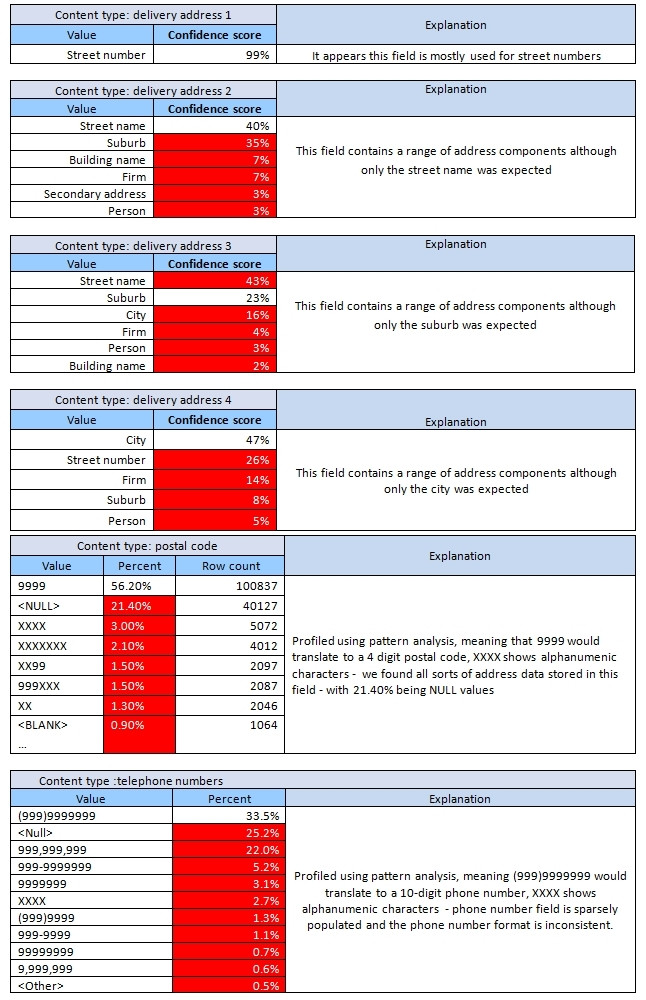
An example of the output on customer master data:
Content type: This is the field name in the source data
Delivery address 1: Street number - numeric > 0
Delivery address 2: Street name - text
Delivery address 3: Suburb - text
Delivery address 4: City - text
Postal code: Postal code - four-digit numeric
Conclusion
There is no clear structure of the address fields and the fields are used inconsistently, eg, delivery address 2 and delivery address 3 are both used for street name.
Postal code has 43.8% 'dirty data'.
Telephone numbers also has 66.5% 'dirty data'.
A data quality assessment can inform any company as to where the risks are within the data, increasing visibility to data quality issues, and at the same time, provide, identify and quantify the needs for a data governance strategy.
For more information, please visit www.ixiaconsulting.co.za.
Share


Editorial contacts