
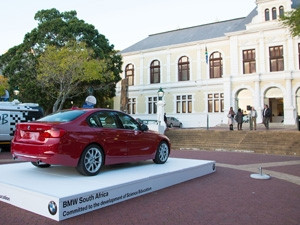
BMW SA last week donated five BMW 3 Series educational display cars to the Department of Science and Technology (DST). The vehicles will be displayed at science centres in five provinces.
The handover of the first educational display car, to the Cape Town Science Centre, coincided with the tabling of the DST's 2013/14 budget. The remaining four educational display cars will be handed over in the coming months to science centres in the four other provinces.
General manager of communications and public affairs for BMW SA, Guy Kilfoil, says BMW did not want to adopt a cheque book approach to its community engagements. "We try to contribute to sustainable development, and being a highly technological company, we have recognised the glaring need for the advancement of maths and science education in SA."
Kilfoil says when BMW started production of the new 3 Series in March last year, its production plant in Rosslyn, Pretoria, produced a number of so-called "pre-series" cars. "These vehicles contain many prototype parts and are only built to ensure the production processes are stable and working correctly. As such, these cars can never be sold to customers and, under ordinary circumstances, we would send these cars to be crushed."
Instead of destroying the cars, Kilfoil says BMW decided it would donate them to the DST for use in science centres around the country. The educational cars build on BMW's existing Maths, Science and Technology (MST) Project, which runs in 42 schools around the country that serve historically-disadvantaged communities. "More than 40 000 learners and 148 teachers are direct beneficiaries of this project, while the average maths and science pass rates at the BMW MST schools exceed the national averages for these subjects by more than 20%," says Kilfoil.
He adds that BMW is finalising the exact way in which these cars will be displayed in the science centres. "The displays will use graphics, text and video material to highlight basic scientific concepts, such as inertia, acceleration, combustion, friction, and how they are present in and enable cars to perform the way that they do."
Practical power
Kilfoil believes that if maths and science are learnt practically, it can further heighten the interest of young people in maths, science and technology by using everyday objects to make these concepts accessible and tangible. "From a personal perspective, I definitely found it far easier to learn about electrical circuits by playing around with some batteries, connectors and light bulbs, than from a text book."
Science and technology minister Derek Hanekom says BMW's donation further enhances the DST's efforts to bring science and technology closer to the youth and getting the public to appreciate the value of science, engineering and technology.
The DST also has its own youth development programme, which is aimed at increasing the youth's access to science, engineering and technology, and stimulating learners' interest in science, technology, engineering, mathematics and innovation.
Hanekom says the department is targeting all learners, parents and other influential sections of society. "Existing initiatives led and supported by the DST include the annual National Science Week, science festivals, as well as awareness and engagement activities driven by science centres."
Time of need
While various efforts like BMW's MST project promote and address the importance of maths and science, SA still needs a lot more participation from government and the private sector to get the standard of these subjects up to scratch.
At a panel discussion held by Neotel earlier this month, the importance of government's involvement in the education of maths and science was highlighted.
One of the panellists, education analyst Graeme Bloch, called on leaders in the education sector to intervene and improve the quality of outcome around maths and science to produce a better quality ICT workforce.
"There is no doubt we need to do a lot better in maths and science, whether we are looking at the Teacher Information Management System for an international standard, or our own indigenous annual assessment."
Bloch says Africa is in dire need of proper maths and science education. "We need maths and science in Africa, because of the Square Kilometre Array telescope, and because of [diseases like] HIV and malaria."
Share

