
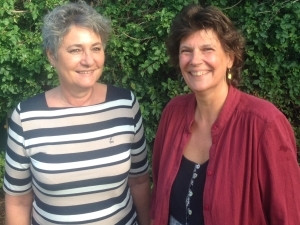
Professor Ren'ee C Kraan-Korteweg and Dr Anja Schr"oder want to do more to put SA's astronomy field on the global map.
The local astronomers last month made headlines after helping to discover hidden galaxies beyond the Milky Way.
In a groundbreaking discovery, the two, together with a team of international scientists, played a leading role in finding a total of 883 galaxies, about half of which had never been seen before.
They say the discovery of the hidden galaxies mostly focused on the southern side of the Milky Way, and now their latest challenge is to head north.
ITWeb caught up with Kraan-Korteweg, chair of astronomy at the University of Cape Town (UCT), and her close collaborator, Schr"oder, from the South African Astronomical Observatory (SAAO), to discuss their latest feat and future ambitions.
Kraan-Korteweg explains the hidden galaxies presented in their research results were taken with the Parkes Radio Telescope, which is in Australia, hence could only cover the southern sky.
"We are pursuing a similar kind of project that will also encompass the northern sky," says Kraan-Korteweg. "Hopefully, we will be able to present work on that within the next year or two.
"And, with another team that I am leading, we are also on the verge of uncovering an even larger hidden over-density but at higher distances that could have interesting implications in understanding galaxy flow fields on large scales and also cosmology. But we do need more data to quantify the full extent and mass of this structure."
Describing their next challenge, Schr"oder says they will continue searching. "On the other hand, we need to get more information on the galaxies we have found, using near-infrared wavelengths."
She points out that with that information, they can refine the 3D map of the galaxies. "Finally, we need to analyse the distribution of mass that these galaxies represent and find out how strongly they pull us and in which direction."
The two point out that SA is doing enough to encourage women to enter the astronomy field. According to Schr"oder, about 40% astronomers at SAAO are female.
"We are not doing too badly in South Africa, but it is not where we would like to be," says Kraan-Korteweg. "However, compared to other STEM fields, astronomy is much better off than physics or mathematics."
Interestingly, she adds, the theoretical research streams are less well represented by women than observational astronomy.
"The landscape is changing rapidly though, and among the postgraduate students I have supervised at UCT, about half of them were women. And we are also very proud that half of the academic staff members at the UCT Astronomy Department are women. When I joined the efforts in building up astronomy in 2005, and took up the headship of this department, I was its first-ever female academic staff member."
However, she points out it does remain a concern that the fraction of female astronomers at more senior levels is much lower.
Share

