
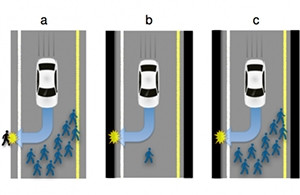
Research highlighted in the MIT Technology Review looks at the ethical dilemma of self-driving cars: if placed in an unavoidable accident where both choices will result in death, should the car be programmed to minimise death toll, even if it means killing the driver of the car.
"The wide adoption of self-driving, autonomous vehicles (AVs) promises to dramatically reduce the number of traffic accidents. Some accidents, though, will be inevitable, because some situations will require AVs to choose the lesser of two evils," the report reads.
"For example, running over a pedestrian on the road or a passer-by on the side; or choosing whether to run over a group of pedestrians or to sacrifice the passenger by driving into a wall."
Jean-Francois Bonnefon, from the Toulouse School of Economics in France where the research was conducted, polled public opinion on the matter. He found most people would have the car programmed to minimise death toll. However, if this was the case, most people would not want to drive an autonomous car themselves.
The report states moral algorithms will need to be programmed into the cars to accomplish three "potentially incompatible objectives: being consistent, not causing public outrage, and not discouraging buyers.
"We argue to achieve these objectives, manufacturers and regulators will need psychologists to apply the methods of experimental ethics to situations involving AVs and unavoidable harm."
Arthur Goldstuck, MD of World Wide Worx says, the report is alarmist speculation looking at the worst case scenario. "The reduction of driver error far outweighs the possibility of this situation."
Goldstuck says the current concept cars for 2025 are a hybrid mix between manual and autonomous technology. "The car will be in constant communication with surrounding sensors and the driver; when it approaches a place where there is a lot of people, the car will switch to manual.
"People themselves will have to decide who to kill."
However, Goldstuck believes car safety features will improve in tandem with autonomous technology. This means if a car approaches a potential accident, it will be designed to slow down or stop very quickly, making the described ethical situation an improbable.
"There is intensive R&D being done on the technology and such enthusiasm right now," says Goldstuck. "It will not take longer than 15 years for the cars to reach streets.
"There will be fully-functioning self-driving cars in mainstream production in mature markets by 2020, with South Africa following a few years later.
"After the Internet and mobile communication, autonomous cars will be the biggest technology advancement in our lifetimes - transforming daily functions completely."
Share

