Over the past 20 years, I have been studying and working with heuristics, sometimes known as rules of thumb, says Craig Martin, founder and CEO of DesignChain Australia and founder and director of TribalMind.
They are the recipes that you use to make decisions based on limited time and knowledge. They are sometimes referred to as "gut instinct" or intuition. You and I use them every day. They make us who we are, they shape how we think, and they have been created by our experiences and our environment.
* Malcolm Gladwell wrote about them in his book, "Blink". He sought to understand what made snap decisions from specific individuals with less information more accurate than those with more information.
* The CIA commissioned a study to try and understand what made one intelligence analyst's decisions accurate with less information than another who made the wrong decision with more.
* John Boyd, the military strategist, referred to heuristics in his OODA loop. It stands for observe, orient, decide and act. According to Boyd, the second O, orientation, is the repository of our genetic heritage, cultural tradition, and previous experiences.
"It is the most important part of the O-O-D-A loop, since it shapes the way we observe, the way we decide, the way we act." It is the lens that we look through after we observe something, and this lens helps us make decisions. In other words, the orient lens is our heuristics.
All of these point to heuristics and how they are created and coded into our mental models. Depending on how well they have been "coded", we tend to make better decisions. Those with better heuristics make decisions that are more accurate more of the time. Because of this, they tend to earn more. How you code your heuristics into your brain is therefore correlated to how much money and success you may achieve.
The challenge for most individuals is that of bounded rationality. "Bounded rationality is the idea that in decision-making, rationality of individuals is limited by the information they have, the cognitive limitations of their minds, and the finite amount of time they have to make a decision." And due these constraints, the decisions, and the accuracy of these decisions, are limited.
The bottom line, if your heuristics are dated, so too is your thinking. Ouch! This isn't just the content or output of your thinking, but the actual mental models and rules you use to create insight and make better decisions. In today's fast-paced world where innovation and creativity are becoming more and more sought after, those individuals who are unable to reboot or re-code their heuristics, are doomed to fade into the pit of old ideas and incremental improvements.
This is why the discipline of design thinking has been getting so much press. Design thinking is a means to re-code your heuristics. However, the way design is currently being used, marketed, sold and delivered is far from this agenda. As usual, when the buzzword hits the market, it gets thrown into every strategy, sales pitch, Web site, campaign, and tweet. What I see in the market is often what I would refer to as human-centred design. A way to put the human in the centre and shape a series of products and services around this human. HCD is a sub-set of design thinking, but not its main manifesto.
Even lower down on the spectrum, a number of design meet-ups I have attended seem to attract mainly those individuals in the graphic design discipline, Web site developers, app developers, et al. Also a sub-set of the design thinking discipline.
What's key is the term 'thinking'. It's exactly that, a mind-set, a way to think, and a way to bend and reshape your heuristics into new mental models that can help you invent, innovate and disrupt more successfully. Yes, it still includes graphic design, HCD and all those, but these are much more successful if you change your thinking first; these other aspects are just the outcomes.
This is highly relevant to you as a business decision-maker. You know that you are only as good as your last successful idea, product, service or decision. In today's fast-paced world, you need to adapt your thinking to keep up with the competition inside and outside of your organisation. In order to do this, you need to start tackling those spaces that I refer to as the "smelly areas". The ones that no one wants to tackle, the ones riddled with politics, policy, repeated failures, people issues, complexity, ambiguity and messiness.
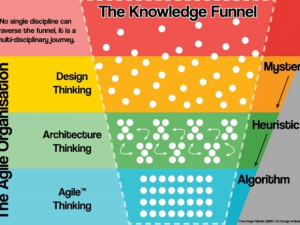
It's scary to feel that not only are you aging physically, but that your mental models and how you make decisions are too. To stay relevant, you need to learn and understand the discipline of design thinking, and how this can be used to snap you out of dated heuristics, and help you cope with complexity, ambiguity and messiness.
The good news is that this is the space that design thinking is perfect for; the domain of mystery, wicked and "smelly problems". No longer do you have to fear these dark corners. Design gives you a way to tackle these in a structured fashion. It allows you to re-code some of your heuristics and mental models, to learn fast and adapt fast and to create a truly agile and adaptive mind-set and organisation.
It's time to reboot your mental models. But how?
Knotion Consulting can help you re-code your thinking with the Design in Business Training, presented by Craig Martin, founder and CEO of DesignChain Australia and founder and Director of TribalMind. Visit the Knotion Consulting Web site for more information: www.knotion.net.
Share


Editorial contacts