
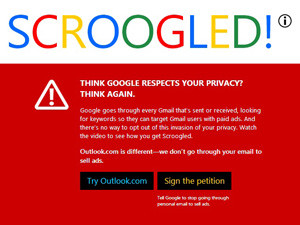
The "Scroogled" campaign that was launched by Microsoft against Google's Gmail service last week has attracted just over 6 000 signatures for its petition so far - which is approximately 0.002% of Gmail's user base.
The campaign seeks to inform Gmail users of Google's ad targeting practices, and claims that by scanning users' e-mails in order to gain ad targeting information, the search giant is invading its users' privacy. Apart from encouraging users to switch from Gmail, the campaign also invites them to sign a petition to "tell Google to stop going through your e-mails".
The petition states: "Google earns money by violating your privacy. They go through every word of your personal Gmail so they can target you with ads. Every word of every e-mail. Even the most private ones. Do you feel violated yet?"
As noted by Marketing Land, if the campaign's intention was to get users to rise up against Google, it does not appear to be succeeding: "The Gmail user base is reported at between 300 million to 425 million users. Rounding up to 6 000 signatures, and using the lowest 300 million figure, means that, potentially, 0.002% of Gmail users have used the petition to join Microsoft's protest." It is also noted that not all of the petition's signatories are Gmail users, so that figure could be even lower.
The lack of interest in the campaign and in Microsoft's claims against Google, appears to contradict the many research reports and surveys about users' privacy concerns, to which the Scroogled campaign refers.
A GfK Roper study (commissioned by Microsoft) surveyed just over 1 000 Americans and found that 70% of respondents didn't know or didn't think any major e-mail service currently scans the content of personal e-mails in order to target ads at its users.
Following from that, 88% of respondents said they would disapprove of their e-mail service scanning their e-mails, a further 83% said they would view this as an invasion of privacy. Eighty-nine percent also said they believed no e-mail service provider should be allowed to scan the content of personal e-mails.
Independent market research company Mozaic Group also conducted a study (also commissioned by Microsoft) using a representative sample of 2 000 Gmail users. According to its findings, 88% of respondents said Google should not use e-mail content to deliver targeted ads. A solid 60% of the respondents also said they would consider or definitely switch away from Gmail because of this practice.
It's not just Gmail that users are said to be concerned about though, and the Pew Internet & American Life Survey 2012 revealed that 65% of users disliked the idea of a search engine collecting information about their searches for targeted advertising. Seventy-three percent of Internet users surveyed also said they think a search engine tracking and personalising search results was an "invasion of privacy".
Privacy confusion
Google altered its privacy policy early last year - consolidating its disparate policies for its different services into a single policy that spans all of its services and made it easier for Google to combine its user data. However, the actual practice of scanning e-mails for ad targeting dates back to when Gmail first launched. Gmail launched as an invitation-only beta service in 2004, and officially became publicly available in 2007.
When news of Google's new webmail service first broke, it sparked a major debate over potential privacy issues - especially due to its ability to scan e-mail contents for ad targeting purposes. At the time, this was still a relatively new practice and privacy concerns were examined from all angles - and ultimately died down.
Looking at the comments posted on Microsoft's petition, it would appear as if the majority of those signing their names to the cause are actually somewhat confused about what Google is said to be doing, and what they should be outraged about:
"This is an invasion of privacy and thoroughly turns me off all tweeting."
"This illegal for a company as large and great as this to be operating in this manner. They should be fined a substantial amount of money when this is investigated and proven to be true. And the amount should be shared among the numerous amount of people found who's e-mail has been tampered with by them." (sic)
"If you want to obtain money think of something better than invading people's privacy. Breach of privacy act is imprisonment in case you didn't know. I suggest you also think about your moral standing. You will also lose a lot of customers by doing this unwanted behaviour." (sic)
Some even added their names to the petition just to take a stab at Microsoft:
"So many Microsoft employees and officials are signing here I see..."
"Proud user of all Google services here. Microsoft = extremely desperate! Microsoft are a useless bunch of pansies who are failing to compete successfully in the market so they must belittle the successful with ridiculous ad campaigns. Fail Microsoft!!" (sic)
It has also been noted that Microsoft itself scans users' e-mail, although not for the purpose of serving ads. Microsoft says Outlook.com scans e-mails to protect its users from spam, malware and other "dangers and annoyances".
Share

