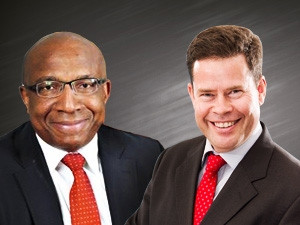
Whereas the appointment of Sipho Maseko as Telkom's new CEO has largely been welcomed by the market, much of the optimism stems from the announcement that telecoms stalwart Dr Brian Armstrong would fill the position of group COO.
Analysts this morning agreed that the highly-regarded Armstrong - until now MD of Telkom Business - is the trump card that will strengthen Maseko's leadership position, as the latter takes over the reins from Nombulelo "Pinky" Moholi, who announced her resignation last year.
Maseko is considered fairly inexperienced in the telecoms space, having previously served as MD of Vodacom for less than a year. However, market observers believe Armstrong's 25 years' experience in ICT and telecommunications will negate any potential weakness stemming from Maseko's limited exposure to the industry.
Despite this, analysts have cautioned that a successful turnaround for Telkom hinges mainly on government's pending decision regarding a strategic direction for the company, and the current lack of clarity is seen as Telkom's biggest stumbling block.
"Telkom faces heaps of challenges, but I hope that the appointment of a strong board, CEO and COO will send a message to government that there must be some clarity around its decision for Telkom," says Ovum senior analyst Richard Hurst.
As the largest single shareholder, government holds a 39.7% direct stake in Telkom and another 10.6% indirect interest though the state-owned Public Investment Corporation (PIC). The state has repeatedly been accused of interfering with the running of Telkom. The market is still smarting from government's move last June to pull the plug on a potential deal with Korea-based KT Corporation, which would have seen Telkom issue 20% more shares in return for an initial R3.3 billion injection.
The Department of Communications (DOC) subsequently announced it would report back to Cabinet with options for a turnaround plan for Telkom, within three months of the cancelled deal, but this has been delayed.
"I have a feeling that the new board is strong and that government has realised that it can't interfere overly [in the running of Telkom]," says Hurst, adding that the fixed-line operator still has an important role to play in the country's telecoms space.
Hurst notes that Telkom has the biggest fibre network in the country and holds a large chunk of the local broadband and enterprise market, which it now needs to translate into a global business. He also speculates that a strategic equity partner is likely to be announced for Telkom in the near future - "someone from the Indian subcontinent".
'Too big to fail'
BMI-TechKnowledge MD Denis Smit says Maseko is facing a tough job, but also feels that Armstrong will be there to prop him up. "The appointment of Armstrong is a good move, and it seems that Telkom now has a strong board."
Smit also believes government's next move is pivotal for the future of Telkom. "Government must proclaim what it wants to do. There are so many issues facing Telkom, the board and government must develop a strategic direction. Telkom is too big to fail."
While Smit says he is not optimistic about government's urgency to announce a strategic path for Telkom - whether it should be split into separate wholesale and retail units - he says the state owes minority shareholders some clarity.
In the meantime, he says, it is vital for Telkom to continue with its planned retrenchment process, as it needs to cut operating costs.
The operator recently said it was undergoing a voluntary early retirement process to "take control of its headcount costs". Unions have hit out at Telkom, threatening strike action in light of its workforce-trimming exercise, and accusing the telco of using it as a ploy to retrench thousands of employees.
However, Telkom has dismissed hearsay that it intends to retrench 13 000 employees, saying "no such decision has been taken".
'Arrogantly ignoring'
Vestact analyst Sasha Naryshkine also agrees that, although Maseko has drive, there is only one problem: government.
Government, he explains, is arrogantly ignoring the other 60% of shareholders and has renamed Telkom a state-owned company when it does not even own half.
"The only thing that we can note from this name change is that government is oblivious to the minority shareholders. So much so, that the mere renaming of the business suggests as much. So, the more it changes, I suspect that the meddling will stay as government is again told by their core support base that they must continue to do more."
Telkom is currently undervalued and the biggest obstacle to its growth is that the state has yet to put a plan on the table to provide a future strategy for the entity, says Naryshkine.
The announcement of the two appointments initially bolstered the share price. On Thursday, after news of the appointments, Telkom's share closed at R15, and it lost slight ground yesterday to close at R14.80.
Telkom's turnover has levelled out in the past five years, while its market capitalisation has lost 30% ? excluding former subsidiary Vodacom - in the same time period. Telkom is now worth R7.7 billion, while Vodacom - in which it had a 50% stake before spinning it off three years ago - is currently worth R166.2 billion.
Telkom is battling with a heavy cost base and is losing customers, says Naryshkine. He adds that once long-term evolution takes off, the company will see more clients moving to mobile.
The operator currently has about 3.9 million subscribers in total, compared with MTN's South African base of 25.4 million and Vodacom's 30.6 million. In the six months to September, total revenue was R16 billion, but operating expenditure came in at R15.6 billion.
Communications minister Dina Pule recently told ITWeb during an interview that a strategic plan for Telkom would be announced imminently. Pule said she had met with Telkom's board in recent weeks and is waiting for the company's directors to present a future strategy to the DOC.
However, she insisted government has no plans to dictate what this strategy should be, but that it would only guide Telkom in terms of policy directives.
Share

