
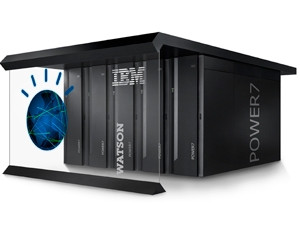
African scientists are set to receive access to IBM's artificial intelligence supercomputer Watson, as well as other cognitive systems in a $100 million project to bring the technology to the continent through project Lucy.
Project Lucy, a 10-year initiative, will initially be based at IBM's new Africa Research laboratory, in Nairobi, Kenya. IBM chose the moniker for the project after the earliest known human ancestor. The move follows IBM's January announcement of a $1 billion investment into the supercomputer unit.
Lucy creates the potential for Africans to use the cutting-edge technology to deal with African data in a bid to solve problems plaguing the continent in areas such as healthcare, education, water and sanitation, human mobility and agriculture.
Watson, which shot to fame when it won a Jeopardy! television quiz, represents a new era of cognitive computing, says IBM. It explains the system improves by learning so it can discover answers to questions and uncover insights by analysing massive amounts of big data.
To help fuel the cognitive computing market and build an ecosystem around Watson, IBM will also establish a new pan-African Centre of Excellence for Data-Driven Development (CEDD), and is recruiting research partners such as universities, development agencies, start-ups and clients in Africa and around the world.
The company is also set to open new innovation centres in Lagos, Nigeria; Casablanca, Morocco; and Johannesburg, South Africa, it says.
Super technology
"In the last decade, Africa has been a tremendous growth story - yet the continent's challenges, stemming from population growth, water scarcity, disease, low agricultural yield and other factors are impediments to inclusive economic growth," said Kamal Bhattacharya, director of IBM Research for Africa.
"With the ability to learn from emerging patterns and discover new correlations, Watson's cognitive capabilities hold enormous potential in Africa - helping it to achieve in the next two decades what today's developed markets have achieved over two centuries."
IBM says deploying Watson technologies from its new Africa Research laboratory, in Kenya, will provide researchers with "a powerful set of resources to help develop commercially-viable solutions in key areas such as healthcare, education, water and sanitation, human mobility and agriculture".
Professor Rahamon Bello, vice-chancellor of the University of Lagos, says if Africa is to join, and eventually leapfrog, other economies, the continent needs comprehensive investments in science and technology that are well integrated with economic planning and aligned to the African landscape.
"I see a great opportunity for innovative research partnerships between companies like IBM and African organisations, bringing together the world's most advanced technologies with local expertise and knowledge."
Critical areas
The pan-African CEDD will make use of the latest Watson cognitive technologies to provide IBM's research partners with access to high-frequency and better organised data. "This will enable scientists and analysts to more accurately calculate social and economic conditions and identify previously unseen correlations across multiple domains," says the computing company.
About Watson
Watson was named after IBM founder Thomas Watson and was developed in IBM's research labs. It uses natural language processing and analytics to process information in a similar way as to how people think.
The project began in 2006, with a team of IBM researchers collaborating with leading universities on a project called "Deep QA".
IBM now delivers the technology from the cloud, so Watson is no longer the size of a master bedroom, but rather three stacked pizza boxes.
Through project Lucy, partners will be able to tap into IBM's expertise in cognitive computing across its 12 global laboratories and new Watson business unit and gain access to the resources, tools and knowledge-based services necessary for developing cognitive computing innovations, it says.
Two of the CEDD's first focus of attention will be on healthcare and education, says IBM. It notes sub-Saharan Africa is home to around 25% of the world's disease burden, yet the most common form of healthcare outside of cities is delivered by community health workers.
CEDD will collect encyclopaedic knowledge about traditional and non-traditional diseases in Africa and, through Watson's cognitive intelligence, doctors, nurses and field workers will be aided to diagnose illnesses and identify treatment.
"By feeding back valuable clinical data about their field observations, healthcare workers will be able to contribute to improving Watson's inference abilities," says IBM.
Its other focus - education - aims to provide insights into student performance, teacher expertise, attendance levels, class sizes, linguistic abilities and learning materials. IBM says the centre, through its use of Watson technologies, aims to create a holistic approach to analysing data to identify previously unrecorded correlations.
For example, Watson could identify the link between a contaminated water borehole, an epidemic of cholera and the subsequent low levels of school attendance in the region, the computing giant explains.
Incredible opportunities
Professor Barry Dwolatzky, director and CEO of the University of Witwatersrand's Joburg Centre for Software Engineering unit, says Watson could be used for many applications. He says bringing Watson to Africa will enable scientists to use cognitive computing against data from the continent to try and solve its problems.
"If they collect data and pose African questions to African data, we can start to do quite innovative things." The $100 million - about R1.1 billon initiative - is open to scientists and IBM partners, who will be able to tap into cloud-delivered cognitive intelligence.
The cutting-edge artificial intelligence has "huge potential" for the continent, says Dwolatzky. He says it is typically used to probe first-world problems, but now there is the "exciting" opportunity to find out "all sorts of amazing things" in Africa.
Dwolatzky explains connections between the growing amount of data can be used to extrapolate information, such as the correlation between shopping habits and the weather. However, the challenge is how to connect databases and make sense of the information.
Cognitive computing, which is what Watson does, is one way of extracting information and knowledge from data, says Dwolatzky. He notes IBM has done vast amounts of research in solving the computing problem of reverse reasoning, which was demonstrated in the Jeopardy! programme.
Share

