
WeBuyCars is stepping up its investment in technology, artificial intelligence (AI) and data-driven pricing models, as it looks to defend and grow its market share amid intensifying competition from Chinese and other Asian vehicle brands.
The used-car retailer is betting that its proprietary technology, vehicle data and predictive pricing capabilities will help it navigate a market characterised by falling used-car prices, increasingly affordable new vehicles and pressure on profit margins.
The strategy comes as WeBuyCars reported an 18.5% decline in headline earnings to R764.2 million for the year ended 30 September, despite growing revenue by 7.2% to R28.3 billion.

Speaking to ITWeb yesterday following the release of the results, co-founder and CEO Faan van der Walt said the group has maintained and slightly increased its share of the used-vehicle market during a difficult trading year.
WeBuyCars estimates its market share at about 11%, while its audited results put its share of used-vehicle registrations at 10.7%, up from 10.3% in the previous financial year.
“The market was in a period of deflation, and so for us, this was a successful year for various reasons. We produced a solid set of results in tough economic circumstances,” Van der Walt said.
He noted the company has deliberately continued investing in its infrastructure, technology and expansion programme, rather than retreating in response to weaker trading conditions.
“When you are a farmer and you have a drought, most farmers would sell land or borrow more money. What we have done in a period of drought is buy the farm next door,” he said.
The company bought 185 943 vehicles during the year, up 3%, while sales increased 4% to 186 220 units. Its monthly sales reached a record 17 209 vehicles in March.
However, higher volumes did not translate into stronger earnings, as the company reduced selling prices to protect stock turnover and avoid being left with vehicles whose values were declining.
Balancing act
Van der Walt said WeBuyCars received a record number of leads from motorists wanting to sell their vehicles and evaluated a record number of cars. However, the company has become more conservative when making offers.
He attributed this partly to sellers struggling to accept the lower market values of their vehicles, with many still owing more on vehicle finance than their cars were worth.
The proportion of motorists who rejected WeBuyCars’ offers and still had their vehicles six weeks later increased from 67% a year earlier to 79%, he said.

This has created a difficult environment for used-car dealers, who must balance competitive buying prices against the risk of holding depreciating stock.
WeBuyCars says the pressure on margins was particularly pronounced in vehicles competing with competitively priced new models from Chinese and other Asian manufacturers.
The company’s results note that Chinese and other Asian brands accounted for 20% of new passenger vehicle sales in 2026, compared with 13.8% in 2025 and 9.2% in 2024.
Van der Walt cautioned against treating all Chinese manufacturers as one category, saying some brands had established themselves in South Africa over many years, while others were still finding their footing.
He also warned motorists to look beyond purchase prices and vehicle specifications when choosing a new vehicle.
Consumers should consider depreciation, the availability of spare parts, servicing costs and the manufacturer's dealer network, he said.
WeBuyCars believes the growing number of Asian vehicles entering the market will eventually create opportunities for its used-car business as those vehicles reach the second-hand market.
Betting on data and AI
Technology is central to WeBuyCars’ response to the changing market, with the group using proprietary predictive pricing models that combine its own vehicle data with broader market information.
Van der Walt said the system allows the company to adjust prices to changing market conditions without the delays that can affect traditional vehicle valuation approaches.
“Every vehicle that we evaluate is important to us because we gather more and more data, and every day we enrich our data sets. That enables us to price vehicles accurately,” he said.
The company also uses the technology to maintain relatively short inventory cycles, with stock turning in fewer than 30 days.
Another investment is Inspectify, a vehicle inspection platform that has now been rolled out across all WeBuyCars supermarkets.
The platform uses vehicle diagnostics and other technologies to provide more detailed information about a car’s condition, reliability, expected cost of ownership and maintenance history.
It can also identify information such as whether a vehicle has previously been involved in an accident, giving prospective buyers greater transparency when purchasing used cars.
Van der Walt said the group is also experimenting with AI-driven pricing models to determine the optimal selling price for individual vehicles.
One application involves determining how the asking price of a vehicle should change over time if it does not sell.
The company is currently running eight experiments to establish how best to adjust prices during this process, which it calls price discovery.
The models consider several variables, including the specific vehicle, its location and even its colour.
“It is not a general solution. It is vehicle-specific, location-specific, and even the colour of the vehicle plays a role. It is complex and cannot be done with a spreadsheet,” he said.
The company’s technology investments also underpin its longer-term expansion ambitions, with management targeting monthly buying and selling volumes of 23 000 vehicles by financial year 2028.
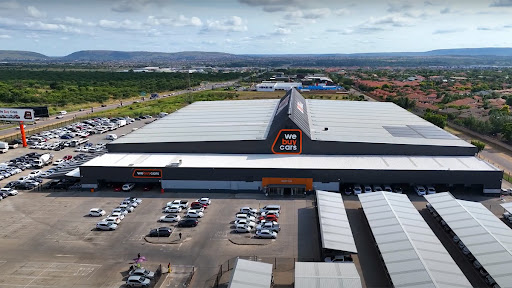
During the reporting period, WeBuyCars increased its national parking capacity by 25.4%, adding 3 283 bays through new and relocated facilities.
The expansion includes supermarkets in Montana, Lansdowne, Witbank and Bloemfontein, as well as a new site for its commercial vehicle business in Centurion.
The group has also secured 2.7 hectares of land in Polokwane, where it plans to develop a larger supermarket during 2027.
Despite the expansion, management says it has taken a conservative approach to vehicle purchases and cleared older stock to protect liquidity.
Net cash generated from operating activities increased 48.2% to R1 billion, compared with R677.3 million in the previous year.
Tech-driven leadership transition
The growing importance of technology and AI will also feature in the group’s leadership transition.
In a voluntary letter to shareholders, co-founders and brothers Faan and Dirk van der Walt said the business is entering a new phase in which technology, data and AI will increasingly shape its competitive advantage.
Faan will step down as CEO on 31 December, with deputy CEO and chief digital officer Dr Wynand Beukes taking over on 1 January.
Beukes, who has been with the business for several years, was appointed deputy CEO in January 2026 as part of its succession planning process.
In the letter, the two brothers say Beukes is well-positioned to lead the next phase of growth, which will increasingly be driven by technology, data and more sophisticated pricing models.
“We are entering the Age of Intelligence, where competitive advantage will increasingly be defined by the ability to combine human judgement, creativity and leadership with the transformative power and capabilities of artificial intelligence,” they say.
Faan will remain on the board as a non-executive director and serve as a consultant to the business, while Dirk will step down as an executive director and become an alternate non-executive director to Faan.
The brothers say they will remain substantial shareholders and continue supporting the company, while giving the incoming leadership team room to take the business forward.
Share

