

Within the past week, several tech stocks – especially those associated with artificial intelligence (AI) – have run up to new heights, with warnings that some of these shares could burst.
Lofty valuations are being reached as tech stocks are proving to be a source of comfort in the current economic environment, with rising inflation in the midst of a geopolitical fallout in the Middle East that shows no signs of ending anytime soon.
Alphabet was edging closer to overtaking NVIDIA as the world’s most valuable company after a rally in its shares lifted its market capitalisation to about $4.67 trillion on Tuesday. Alphabet shares have gained about 25% this year, compared with NVIDIA’s 12%, with the Google parent now worth $4.8 trillion, while NVIDIA comes in at $5.1 trillion.


Nasdaq-listed Advanced Micro Devices’ (AMD’s) shares surged 20% to a record high on Wednesday and it is now worth $665.93 billion. It lifted its second-quarter revenue forecast above analyst expectations on accelerating demand for AI data centre chips.
AMD’s first-quarter revenue was up 32% year-on-year, while data centre revenue more than doubled on strong demand for AI accelerators and server processors.
Samsung Electronics also crossed a milestone on Wednesday, becoming only the second Asian company after Taiwan Semiconductor Manufacturing Company (TSMC) to surpass the $1 trillion valuation mark.
The South Korea-based company is the world’s 11th most valuable at $1.2 trillion, while analysts quoted by Bloomberg expect Samsung shares to climb a further 22% over the next year as demand for advanced chips and computing capacity remains strong. TSMC, meanwhile, is the sixth most valuable firm in the world.
Baby boom
The so-called “Magnificent Seven” – Alphabet, Amazon, Apple, Tesla, Meta Platforms, Microsoft and NVIDIA – are now worth a combined $23 trillion, with that index having gained 37% in rand terms over the past year, according to Mergence.
The stocks are, according to Investopedia, “the most influential companies in the US stock market”.
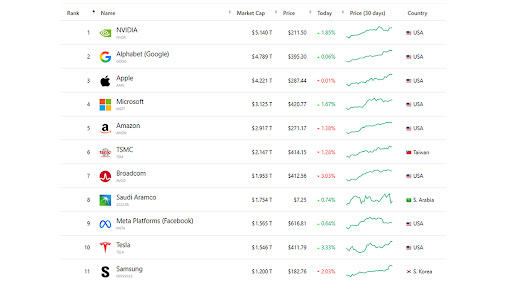
Each of these seven are in the top 10 most valuable companies list, according to companiesmarketcap.com. The term was coined by Bank of America analyst Michael Hartnett in 2023, borrowing from the classic Western film when commenting on these seven companies.
Microsoft was the first to be listed, with Meta being the youngest of the group. Four companies – Amazon, Apple, Microsoft and NVIDIA – survived the dot-com bubble.
Over-achiever
Kriti Gupta, executive director and global investment strategist at JP Morgan Private Bank, says investors continue to buy tech stocks even in the face of “lofty valuations”. She adds: “The sector has been perceived as the answer to everything and everyone.”
Yet, AI stock performance is not currently a one-size-fits-all scenario “as a big gap has opened in the performance of stocks that are participating at different phases and levels of the AI value chain,” notes Peter Takaendesa, chief investment officer at Mergence Investment Managers.

“Over the past 12 months, most of the ‘Magnificent Seven’ stocks are now outperforming the benchmark S&P 500, but Meta and Microsoft have been punished hard.”
This suggests that investors still like the AI theme but are selective in preferring those that can make money right away, such as chipmakers, says Takaendesa. The market is also betting on which company will win the large-language model or AI race to software monetisation, he adds.
Hey, big spender
Takaendesa says the Magnificent Seven are guiding the market that they will spend more than $700 billion in AI-related capital investment in 2026 alone. “Cash flows will surely be challenged over the short-term as they accelerate these AI capital investments.”
Yet, most of the “Magnificent Seven” companies continue to deliver strong earnings growth and strong balance sheets, still generating significant cash from core business segments such as advertising, e-commerce and gaming, comments Takaendesa.

Cash holdings in the Magnificent Seven stocks – which now make up about 35% of the S&P 500 – grew over 300% between 2011 and 2025, says Gupta.
Gupta points out that “a low-interest-rate regime and growing liquidity on its balance sheet, thanks to post-COVID issuance at near-Treasury-level rates and extraordinary free cash flow, helped build the [tech stock] cash cushion”.
Guessing game
“When investors are excited about AI, they have bought tech. When they’re worried about inflation, they bought tech. When looking for outperformance, they bought tech. When thinking about sustainability, they bought tech,” says Gupta.
“When they wanted to invest in growth, they bought tech. When they wanted to lean into the capex cycle, they bought tech. When worried about the world and in need of a company with a cash cushion, they bought tech.”
“There will be winners and losers over time, so one can say bubbles are likely in the making in some cases,” says Takaendesa.
“We believe the truth is no one really knows at this stage who the ultimate winners will be and we can expect to see shifts in those views as time goes on. Investors who want to play this theme should diversify their investments in that space rather than chase a particular stock.”
* All valuations have been provided in dollars for comparison purposes. As of early this morning, the local currency was worth R16.45 to the greenback.
* This article is for informational purposes only and does not constitute financial or investment advice. Past performance does not guarantee future results. Readers should conduct their own research and consult with qualified financial advisors before making investment decisions.
Share

