
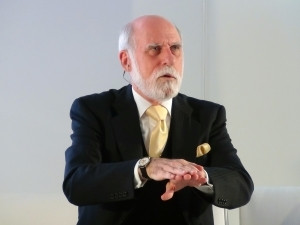
A free, unclogged Internet and 'permissionless' innovation are at the heart of the Internet revolution - an era that will enable economies all over the world.
This is the opinion of Internet pioneer Vint Cerf - Google vice-president and chief evangelist - expressed during a public dialogue with industry players, including SA's new communications minister Yunus Carrim, at a Google Big Tent event, in Johannesburg, yesterday.
In his efforts to increase access to the Internet, Cerf - dubbed one of the "fathers of the Internet" - says he has encountered a number of obstacles that are largely underpinned by regulation.
The stringent regulation of spectrum, he says, is a case in point. "We are not making good use of spectrum right now. We have the means to share [radio wave spectrum] but are not allowed to do it because of regulatory constraints."
He says advances in technology have opened up the potential of spectrum sharing, citing code division multiple access (CDMA) as one such technology. CDMA allows multiple uses of the same spectrum - something previously not possible.
Despite this, says Cerf, "sharing spectrum is something we are not taking advantage of at all".
He says, at any given time, an average of 2% is being used. Cerf says with spectrum sharing, more applications could be pushed through the same band - utilising the available capacity much more effectively.
Google strides
In the meantime, Google is looking to alternative means of increasing access to the Internet and bridging the digital divide.
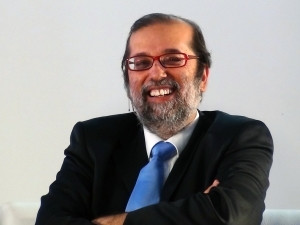
Carrim has commended the search giant for its recent initiative that looks to television white spaces for broadband access in SA's rural and underserviced areas.
Google and other partners, including the Meraka Institute (an ICT research division of the CSIR), launched a TV white spaces broadband trial, in Cape Town, in March.
"Google is actively working with governments and local authorities in countries across Africa to link up the Internet. The results show the technology holds huge possibilities for SA in terms of providing Internet connectivity in rural areas."
Another project under Google's wings is Woza Online - which has now connected 45 000 small and medium enterprises to the Internet via free Web sites. The project is in partnership with Vodacom, LeadSA, and the Department of Trade and Industry.
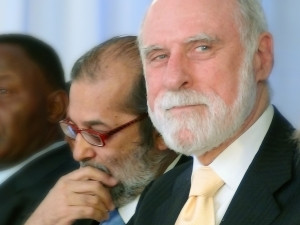
Carrim says it is through initiatives such as these that "we can take our country forward".
These efforts, say Cerf and Carrim, are ultimately aimed at economic progression - which, it is widely accepted correlates closely with an increase in broadband penetration. According to the World Bank, if a country increases broadband adoption by 10%, the gross domestic product increases by almost 1.4% - a figure that is higher in emerging countries.
Carrim says SA needs to be a part of the Internet revolution. "We will either be swept aside by this revolution, or we can utilise our circumstances to further the growth and development of our country.
"Google is at the forefront of the development of the digital global village and bringing us closer than ever before with features such as Google Translate and Google Earth."
He says the impact of broader Internet usage in the developing world in general - but SA in particular - could be huge, "from economic growth, to promoting democratic change via social networking, to combating disease by providing health information and to educating through the Internet".
[VIDEO=http://www.youtube.com/watch?v=omV4rwitFfE]
Share

