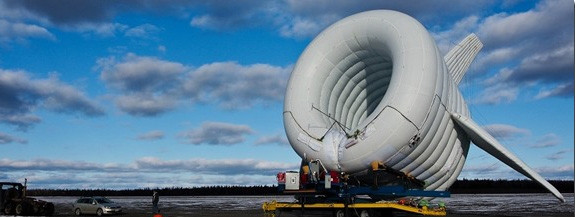
The sky is the new frontier as companies look upwards with drones and high-altitude balloons to provide varying services such as Internet and cellphone reception. An MIT start-up company is looking at the sky to provide the one commodity that everyone requires - power.
Altaeros Energies has built a zeppelin-like airship that is a floating wind turbine. Winds above the ground are much stronger and more consistent, and if the wind speed is double the speed than it is on the ground, the turbine is able to generate almost eight times more energy than traditional land-based wind turbines. And, they cost a lot less too. Once the blimp is filled with helium, it is allowed to float up to its designated location via the tethering system. When in place, the winds spin the turbine, which generates electricity that is sent down the cord to the ground station.
The Altaeros BAT integrates four main components:
* Shell - A proprietary helium-filled shell made from high-performance industrial fabrics that lift the turbine up and stabilise it in the air.
* Turbine - A lightweight, conventional, three-blade, horizontal axis wind turbine, fixed within the shell.
* Tethers - The lightweight, high-strength tethers hold the turbine in place in all weather conditions, and transmit power to the ground.
* Ground station - The portable ground station is rapidly deployed from a shipping container and includes an autonomous control system and power conditioning equipment.
To make this possible, Altaeros Energies has raised $1.3 million, partially financed by the Alaska Energy Authority's Emerging Energy Technology Fund. The company has been working on this project for 18 month, and will deploy the Altaeros BAT (Buoyant Airborne Turbine) at a height of 304 metres above ground as the first long-term demonstration of an airborne wind turbine. This will take place on a site south of Fairbanks, Alaska.
This airborne system could be the answer not only to developed areas, but to rural and remote areas as well as those areas that require power after a natural disaster strike, such as a hurricane or earthquake.
Of course, the added advantage of this floating platform above the ground is that it can also be rigged to provide cellphone coverage and WiFi Internet access. Looks like Google Balloons and Facebook's drones have a real rival on their hands.
This kind of technology looks promising and makes complete sense even to an amateur. Could this be the future solution to our planet's energy problems?
Power from renewable energies will be the next gold rush - I wonder if they are looking for investors?
Share

