
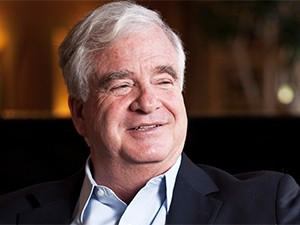
Jerry Kennelly, CEO of Riverbed, runs his company 'like a billion dollar startup', a staffer remarked on Tuesday.
The co-founder of the company, a market leader in the WAN optimisation business, often drops into meetings at its headquarters in San Francisco unannounced, saying 'What you guys talking about?'
"No employee is just a number, and if you joined the company yesterday, he's still interested in your opinion," says the staff member.
The 14-year-old company has surpassed $1-billion in annual revenue, and at its convention in New York this week launched its SteelConnect product which it says will replace routers in branch offices. The move means Riverbed will now be going head-to-head with networking giants Cisco and Juniper.
SteelConnect coordinates network connectivity and delivery of apps across hybrid WANs, LANs and cloud networks such as AWS (Amazon Web Services). The functionality will be available on Microsoft's Azure later this year.
Kennelly says half his executive team used to work at Cisco and while he thought the company would be 'smart' to partner with Riverbed, 'they insist on going it alone'.
"Just think. If Cisco in 2005 had agreed to resell the Riverbed Steelhead product, they would have generated $10-billion in revenue. But they were too stubborn to do it, saying 'We'll do it ourselves'."
He says in 2002, there was not 'even a whisper' about cloud, but over a decade later, almost every company has to deal with its economics, investment and complexities.
With SteelConnect, Riverbed is now delivering an application-defined approach to networking that also includes WAN optimisation and performance management.
Hockey stick revenue
Kennelly says Riverbed was founded in 2002 with the idea of overcoming latency in global networks. Two years later, the Canadian government was their first customer, when it bought two of its Steelhead appliances.
The Steelhead, he says, has made 'global computing' possible by overcoming the 'immutable force' of latency, which, even 20 years from now, would always be an issue.
I'm not interested in some guy who bought his stock yesterday and plans to sell it tomorrow and hold it for three days, calling me up and giving me grief about my strategy.
Jerry Kennelly, CEO of Riverbed
By 2009, the company had started to look at visibility control for networks, because while Steelhead 'cures' network problems, their customers needed something to detect the problems.
Leveraging its acquisitions of German company Ocedo, a provider of software-defined WAN solutions, and Atternity, a company based in Tel Aviv that focusses on application performance management and end-user experience, Riverbed has now been able to launch SteelConnect.
Kennelly is clearly excited by the new product, telling ITWeb that it isn't 'just another widget-type deal', and that he expects SteelConnect to produce 'hockey stick revenue' for the company.
He says being a private company has also allowed them to innovate, but if they were public, 'every day some analyst would be publishing a report saying "the hockey stick is due today", and they'd be driving me out of my mind.'
Kennelly says he is trying to build his business, and isn't interested in 'some guy who bought his stock yesterday and plans to sell it tomorrow and hold it for three days, calling me up and giving me grief about my strategy.'
"I'm trying to create a 100-year company that will exist after I'm dead and create long-term value. And so it's easier to do things that are smart for the business in the long term when you're private, when you don't have to watch the stock on Yahoo finance go up and down because people have knee jerk reactions to short term events."
That said, Kennelly is already starting to think about the company's second IPO, which could be as early as next October, or as late as 24 months from now.
"It will depend a little bit on the hockey stick. If it comes in January, the IPO will be faster. If it comes in December, the IPO will be slower. But it doesn't really matter to me, and I don't have set timeline. I want to do it when the company is right. And the company is right when you're showing growth and you're showing profits. Then I'll pull the trigger on the IPO."
Self-driving networks
With regards to innovation, Kennelly says there aren't enough developers in the US, which in part has led him to establish a development centre in Bangalore.
"It's an amazing place. (There's) technology everywhere. I hire many developers in California, and a large percentage come from India," he said.
I'm trying to create a 100-year company that will exist after I'm dead and create long-term value.
Jerry Kennelly, CEO of Riverbed
He has already hired 122 engineers in seven months in Bangalore, and is now busy establishing another centre in Cluje, Romania, where there is also 'a large supply of engineers without a lot of opportunities'.
Asked about networks of the future, Kennelly says there is a concept they call the 'self-driving network' that will automatically find points of presence and use routing according to application knowledge to detect issues in network and server capacity. Extra capacity in cloud servers or network capacity could then be spun up by the system, that would be, he said, 'self-fixing'.
"So you'll need someone like a security guard at a bank, sitting there, half asleep, watching the terminal."
Riverbed has agreements in place with most of the major service providers in the world with regards to the next wave of innovation, known as 'network function virtualisation'.
He says customers would invest in generic computers while the real value would be found in the software that would control applications and services 'on whatever hardware happens to be in the branch office or data centre'.
"So that's where the world is going, and we're perfectly positioned for that world. We have a nice company. People like working for us. We're not assholes. When it's announced that Riverbed is taking over your company, there's a good response. People can be fearful in those environments. We embrace the people. It's all about people."
Share

