
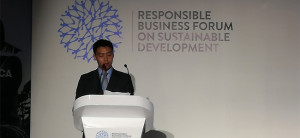
Investment in technology is a key accelerator to help nations achieve the United Nations' Sustainable Development Goals (SDGs), particularly quality education; gender equality; and industry, innovation and infrastructure.
This is according to Huawei South Africa deputy CEO Jacky Zhang, speaking at the Responsible Global Business Forum in Johannesburg last week. The forum is a session with various stakeholders to brainstorm how to fast-track inclusive growth in order to deliver the UN SDGs.
Citing the recently published 2017 ICT Sustainable Development Goals Benchmark Report compiled by Huawei, Zhang said the research showed a 90% correlation between ICT investment and progress in meeting six key SDGs. These goals include good health and well-being, quality education, smart cities and communities, and climate action.
"While the goals are wide-ranging, they have one thing in common: they all rely on the enabling power of technology. Technology will drive inclusive, sustainable growth that is needed for countries to achieve the goals. Huawei has seen how ICT, especially fast connectivity, can create new learning platforms and make radical improvements in the quality and availability of education," he explained.
Zhang added that the firm utilises technologies such as game-based learning, virtual reality and artificial intelligence to create new learning platforms. "Seeds for the Future and the Huawei Authorised Information and Network Academy (HAINA) are some of the projects we are involved in. This sees Huawei partner with government and tertiary institutions to deliver practical training for ICT students and graduates. The first group of 16 HAINA candidates recently graduated from the programme."
Zhang noted that policy support is one of the major stumbling blocks with implementing the latest innovations in SA. "I really wish to have more policy support that will enable us to bring region-specific solutions to the country. We are making some inroads with government, particularly the Department of Telecommunications and Postal Services (DTPS), as we have a common goal to have a digitally transformed South Africa.
"Predictions are that, within the next five to 10 years, we will be living in a super-connected world. With the connections created by the Internet of things, our broadband networks will have to support about 100 billion connections by the year 2025. New technology and solutions are needed," he said.
In July last year, the DTPS, in partnership with Huawei, opened Africa's first Innovation and Experience Centre in Johannesburg, with an investment of R72 million. The centre aims to enhance local ICT skills, create jobs and secure SA's position as the continent's ICT hub.
"That's why we at Huawei believe our most important contribution is to build secure and stable networks that will support ICT as an enabler for sustainable development and growth. We are investing in technological innovations that will help build a better-connected world, reduce the burden on the environment, and enrich the lives of billions of people," concluded Zhang.
Related stories:
Huawei's 7th global innovation centre opens in Joburg
SA's first Huawei HAINA students graduate
Share

