

A year before an arbitrator ruled that the company Raining Men held no claim to a share of any winnings Nkosana Makate might score from his legal battle with Vodacom over Please Call Me, the company was placed in business rescue – and there it remains.
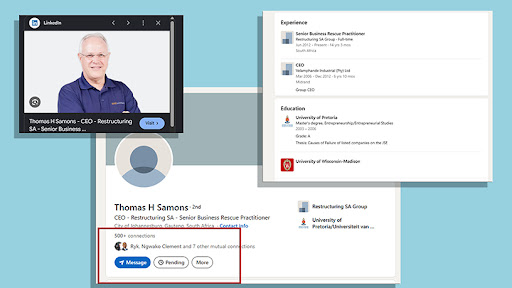
Thomas Samons, who has run Raining Men’s business rescue since 2019, has previously drawn formal criticism: an arbitrator found he “perpetuated” a fraudulent claim, a court later removed him as business rescue practitioner (BRP) of three related state entities for incompetence, and his licence was briefly suspended before being reinstated.
Raining Men’s claim to a share of Makate’s potential millions traces back to 2011, when Chris Schoeman, the litigation funder who would later become central to the fight over who was entitled to the money, signed the first funding deal with Makate.

This company has been in business rescue since January 2019, according to Companies and Intellectual Property Commission (CIPC) records, and remains up to date with its status reports, CIPC spokesman Thabang Setlhare tells ITWeb.
The practice of business rescue was introduced through a 2011 amendment to the Companies Act as a potential alternative to liquidation – and results in the appointment of a BRP, who has temporary control of a company’s affairs, assets and liabilities while a plan is developed to restructure it. Creditors are generally barred from pursuing claims while a company is in business rescue.
Eric Levenstein, head of insolvency and business rescue at Werksmans Attorneys, notes the law contemplates companies emerging from business rescue within three months, although the process can be extended, particularly where more time is needed to conclude an acquisition.
“Business rescue in South Africa is fast becoming the new ‘M&A’ and there is no doubt that acquisition activity in distressed companies is on the increase,” he says, writing about how companies might be salvaged through asset sales or buyouts.
If a company remains in business rescue beyond three months, the CIPC requires status reports to be provided to “each affected person” and either a relevant court or the CIPC.
Empty wallet
In a November 2024 decision dealing with a Samons matter tangent to Please Call Me, Pretoria High Court Judge Harshila Kooverjie said business rescue is only suitable for entities with “reasonable prospects of trading [and that] would be able to gain commercial viability”.
It’s unclear whether Raining Men has any assets, as it is a private company. ITWeb sent Samons and Errol Elsdon, listed by the CIPC as a Raining Men director, three e-mails each asking whether Raining Men holds any assets, but did not receive a response.
There are, however, three key points revealed through the 600-plus pages detailing this case:
- In 2014, it was said to be bankrupt.
- In 2015, it went after a 40% share of Makate’s winnings.
- In 2020, it lost its bid for the right to claim 40c out of every R1 if Makate won.
In a 2018 ruling, Pretoria High Court Judge Neil Tuchten recorded that Chris Schoeman – who signed the first funding deal with Makate in 2011 – sent an e-mail to Black Rock representative Errol Elsdon and early funder Tracey Röscher on 15 December 2014 saying the company was “insolvent”.
This mail was in response to Makate’s lawyer, Wilna Lubbe, requesting R165 000 to continue funding Makate’s battle. Elsdon is currently suing Makate for a share of his Vodacom win on the basis of having provided funding, a claim Makate disputes.
(Biographies on various players in the Please Call Me saga can be found here.)
In that e-mail cited by Judge Tuchten, Schoeman described Raining Men as the “beneficiary and holder of the assets and liabilities” of the funding agreement, while also stating he wasn’t a director of the company.
However, the ruling records him subsequently saying the e-mail should be disregarded because it formed part of a conspiracy against him dating from November 2014.
(Various allegations Schoeman made against Elsdon, Lubbe and Röscher, as well as Elsdon’s allegations of an improper relationship between Schoeman and Lubbe, were unpacked in The Please Call Me millions: Accusations fly.)
Schoeman, a disbarred advocate struck off in 1999, was in court before Tuchten to try to stop ongoing arbitration proceedings and set aside a decision on whether Black Rock, represented by Elsdon, or Raining Men held the rights to a share of Makate’s winnings – before the arbitrator had ruled.
Schoeman instigated arbitration proceedings in 2015 on behalf of Raining Men, and also argued Raining Men was company nominated to fund and benefit from Makate’s lawsuits should he win in a 2016 matter before Tuchten and then reversed this stance in the 2018 matter when he sued Raining Men.
Stand and deliver
The arbitration ruling records the claimants – Schoeman and Raining Men, with Samons later acting for Raining Men – seeking “a declaratory order that Raining Men is a party to the funding agreement through its nomination by Schoeman”. Black Rock, nominated as the funding party in 2013, was confirmed as named company in the funding deal.
(ITWeb unpacked the 2020 arbitration ruling in detail in The Please Call Me millions: The ghost in the deal.)
Despite withdrawing from the arbitration on 15 November 2018, Schoeman took the stand in April 2019 and repeated allegations of a conspiracy to oust him from the deal, this time saying it also involved Lubbe and members of Makate’s legal team. “I am finished with it and that is it,” he said when he withdrew his claim.
However, arbitrator advocate Andrew Mabena found Schoeman’s evidence problematic: “I have observed Schoeman closely during his testimony and cross-examination… When he was confronted with documents which did not support his version, he simply labelled them as lies or as part of a conspiracy.”
Ahead of the April 2019 hearings – which had repeatedly been delayed – Samons was appointed BRP on 21 January 2019. “When Samons was appointed as the BRP of Raining Men, he stepped into the shoes of the directors of Raining Men,” Mabena wrote.
“As BRP, Samons not only managed the financial affairs of the company but also was the driving head of any… litigation instituted by and against Raining Men prior to being placed under business rescue,” the arbitrator says.

In levying punitive costs against Raining Men, Mabena found Samons’s ethical responsibility to the company lacking. “Samons showed no such ethical tendency. He attended the arbitration at certain occasions, promising to revert regarding contributions and then disappeared.”
Mabena also described as "shocking" the reliance Samons, Schoeman and Elsdon placed on the fraudulent transfer of rights from Black Rock to Raining Men, saying the two funders and Samons had "perpetuated" what he called a "disregard for ethical and responsible litigation".
History repeats itself
This is not the first time Samons’s conduct has been found wanting. In a November 2024 case, the North West provincial government sought his removal as BRP for three state-owned entities, citing incompetence, that he was “reckless in his statutory obligations” and failed to exercise proper care, while also alleging illegal conduct.
Judge Kooverjie found that financial statements had not been prepared, the business rescue plan had been delayed, employees had not been paid and Samons had failed to comply with the Public Finance Management Act. The judge removed him as BRP, and a December 2025 judgement dismissed his attempt to overturn the decision.
Separately, the CIPC suspended Samons’s licence in February 2025. He successfully challenged the suspension at the Companies Tribunal last November, which found the suspension invalid. The CIPC’s Setlhare tells ITWeb that Samons is currently a licensed BRP.
ITWeb also provided Samons an opportunity to respond to these statements, via three e-mails to his known addresses and a LinkedIn InMail, without success.
* Next week: As Makate’s fight against Vodacom limped along amid the funders falling out, a magic disappearing act is unveiled.
Share

