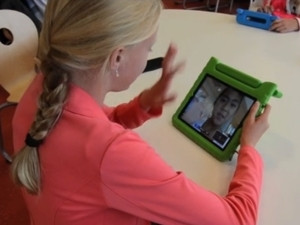
Like most people, my schooling began with a large box of Crayola colouring-in pens and paper. But, if you live in the Netherlands, this is considered so 'old-school', as today's education begins with an iPad.
If you live in the Netherlands, then you have the opportunity to send your child to one of 13 Steve Jobs Schools, which don't allow pens or paper at school, as everything is conducted on the iPad.
The school operates according to the principles of the O4NT foundation (education for a new era), where the programme aims at promoting the child's individual talents and developing skills for the new, tech-savvy world. These skills include information processing, collaboration, and developing a critical, problem-solving and creative mind.
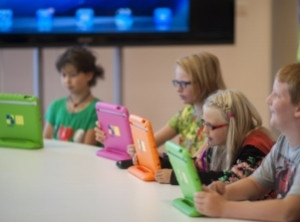
Each child is given an iPad and has access to the virtual school. When the kids are in the physical school building, they move around the various 'subject rooms' according to their individual schedule (we used to call it a timetable), eg, the language room, math room, creative lab, gym or technology lab. They also attend planned activities that they have pre-registered for. Using the iPad and the school software, the children are also able to maintain their own portfolio, documenting their progress and achievements.
Parents can follow exactly what their children have been doing during the day, via a special app.
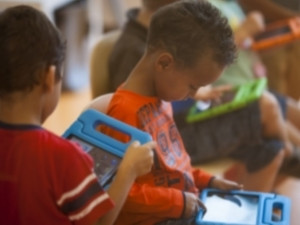
Even the notion of school hours is challenged, and vacations will be flexible once the O4NT method is completely implemented. Because the virtual school is available on the iPad 24/7/365, parents are free to book their holidays at a convenient time, and to determine what their children's school hours will be. School and out-of-school care are seamlessly integrated.
There are also no traditional classroom levels, such as grade 1, grade 2, etc. Only groups of children, clustered together by age. Kids aged between four and seven are in one group, and kids aged between eight and 12 are in another.
This technological approach has a major impact on the role of the teacher. In the O4NT approach, teachers will no longer simply convey knowledge to a group of children; they will be transformed into coaches that support children with their individual and group projects.
Because educational apps are used for basic skills, the learning process can be completely adapted to the individual child's learning speed and style.
Tools of the teaching trade
In order to get this school to operate and achieve its goals, software apps have been developed by or in collaboration with O4NT:
sCoolSpace is a virtual schoolyard where children can meet each other and their coaches digitally. All children design their own avatar, made up from a photograph of their face and a number of special elements. A small circle below the avatar indicates whether or not they are physically present in the school building at that particular time. Students can communicate with each other via instant messaging or by video, using Facetime or Skype. The kids can also display their creative work on the 'Wall of Fame', which is used as an exhibition space for digital creations.
TikTik sCoolTool automatically keeps track of the students' calendars so that teachers and parents can see what their children are doing at school. It automatically logs the students' presence when they arrive at school with their tablet, and will auto-display their schedule. Children can also create their own activities, such as presentations, and invite others to attend. Students can then share their achievements with each other and with the teacher through their personal portfolio, which contains the results of group projects. This means photographs, videos, presentations and screen shots, as well as additional reports, are always available in the digital archives.
sCoolProjects is used to work on research projects and other assignments in small groups, supported by a coach.
iDesk Learning Tracker allows the teachers and parents (and publishers) to follow the results their children achieved using educational apps.
DigiTalenten will report annually on what the students' digital life looks like and what IT skills children have mastered.
Symbaloo is used for sharing and distributing knowledge, within the school as well as between schools and O4NT.
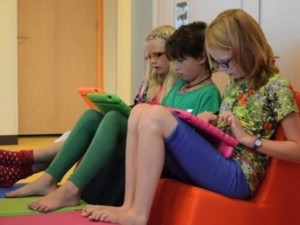
By now, some parents reading this are having heart-failure, but when you see your two-year-old use your iPad way before they can read and write, you realise that today's children are adapting to technology much faster than any generation before - so surely the schooling system needs to be adapting too.
If today's kids are learning through technology then this method of learning plays right to their strength, and will undoubtedly set them up for what the tech world has to throw at them.
Malcolm Gladwell refers to 10 000 hours in his book: "The Tipping Point". This is the amount of hours that someone usually has if they excel in their chosen field. This type of schooling system that identifies and nurtures the individual child's talents will surely massively contribute to the child's 10 000 quota of excellence.
Share

